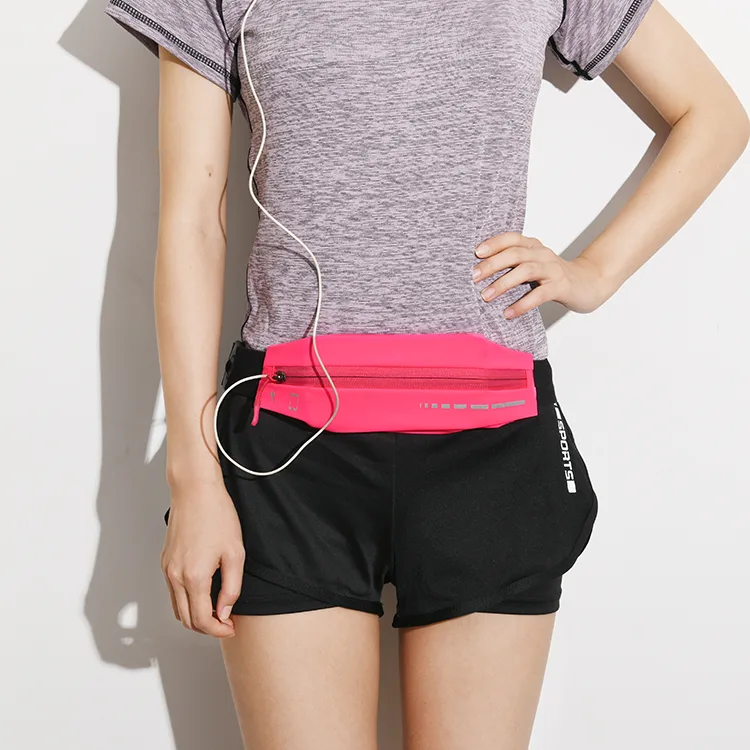
Short answer: yes, but only if three things are true — it sits at your natural waist rather than your hips, it's tight enough that you can't slide it around with one finger, and it's full enough that the contents don't shift. Fail any one of those and it will bounce, no matter how good the bag is.
This comes up constantly, so here are the specifics.
The three conditions, in detail
1. Position — high, not low
Worn on the hips, the bag hangs below your centre of gravity and swings like a pendulum on every stride. Worn at the natural waist, above the hip bone, it moves with your torso instead of against it.
Most people wear it too low because that's more comfortable standing still. It isn't more comfortable running.
2. Tension — tighter than feels normal
A useful test: with the bag on, try to rotate it around your waist with one finger. If it moves, it will bounce.
This is where most fanny packs fail for running. A webbing strap with a side-release buckle holds a fixed circumference, but your waist changes shape as you breathe and stride. A gap opens, and the bag falls into it. Elastic follows the body instead.
3. Fill — a half-empty pouch is worse than a full one
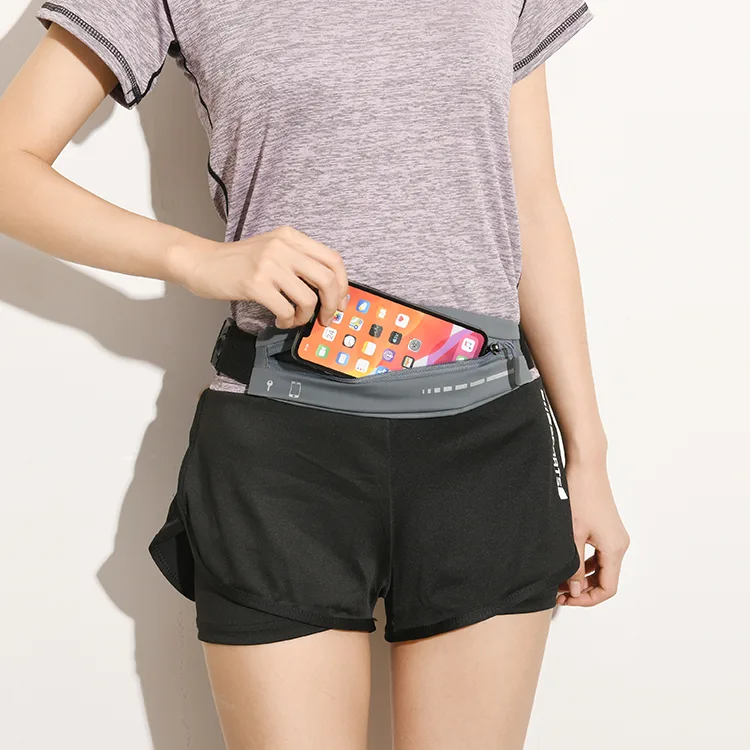
Contents sliding inside the bag reads as bounce even when the belt itself is stable. A phone alone in a large pouch will slap. Either size the bag to what you actually carry, or use a compression pocket.
Fanny pack, running belt or crossbody sling?
| Fanny pack | Running belt | Crossbody sling | |
|---|---|---|---|
| Stability at pace | Depends entirely on fit | Highest | Moderate — swings on faster movement |
| Capacity | Highest | Lowest | Middle |
| Access while moving | Awkward | Designed for it | Reachable but needs a hand |
| Off-duty look | Yes | Usually not | Yes |
| Best for | Travel, walking, city, festivals | Running, gym, hiking | Walking, travel, commuting, light hiking |
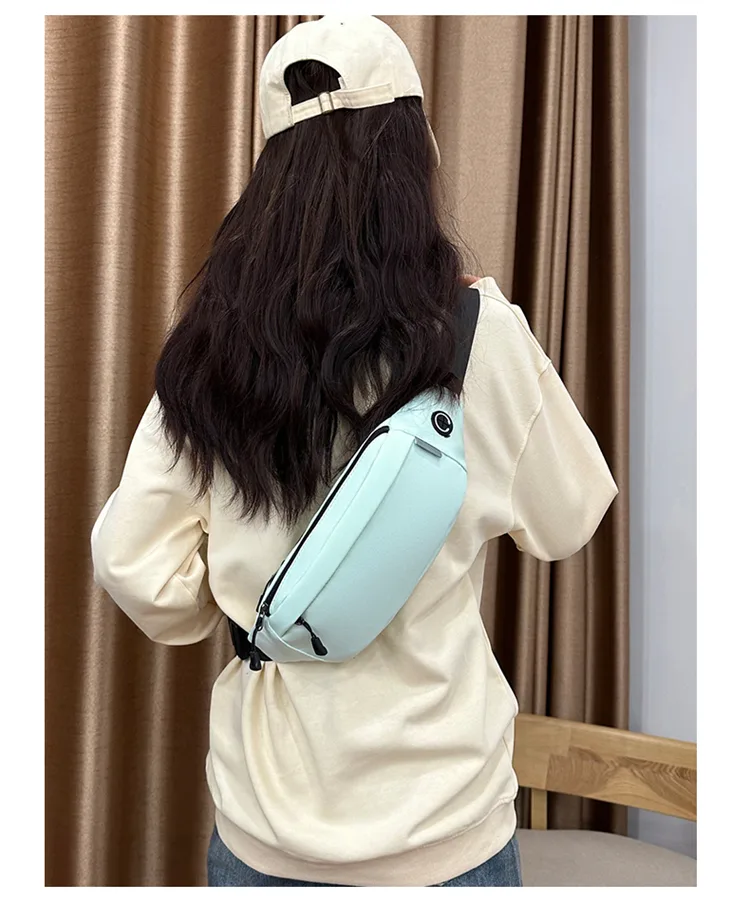
On the "belt bag vs crossbody sling for hands-free workouts" question: for anything with repeated impact — running, HIIT, jump rope — the waist-mounted option wins, because the load sits closer to your centre of mass and the strap doesn't cross a moving shoulder. For walking, cycling and travel, the sling is usually more comfortable and easier to access.
What to check before you buy
- Is the band elastic, webbing, or a hybrid? This one detail decides most of the bounce behaviour
- Is the inner face plain or grippy? Silicone or textured lining stops migration
- Is the pouch built into the band or hanging from it? Integrated is far more stable
- Does the adjustment hold? Some sliders creep loose under repeated load
- Where does the zip pull sit? A hard pull tapping your body for an hour is a real complaint
- Reflective detail if you run in low light
- A port for a cable, if you use wired headphones
If you're producing your own
The mistake we see most often is that the pouch gets all the design attention and the band gets none — then the finished sample bounces and nobody knows why.
Decide these before pattern making, not after:
- Band construction and width
- Waist range you're covering, and whether that means adjustable or multiple sizes
- Inner surface treatment
- Whether the pouch is integrated or suspended
- Closure type and pull style
- Whether a race bib clip is needed
Webbing, elastic, buckles and zippers are sourced to your specification — including a named brand if your project requires one — and checked here before production starts.
Belt bags are sewn on our own floor in Baigou, which is why a strap length or a mesh backing can be changed between samples without a new supplier in the loop. Sampling generally runs 7–15 days, and revisions are made on our own floor.
MOQ from 50 pcs*
Final MOQ depends on style, fabric and logo method. Anna will confirm in your quotation.
See our waist bag range · Running belt vs fanny pack: which one stays put