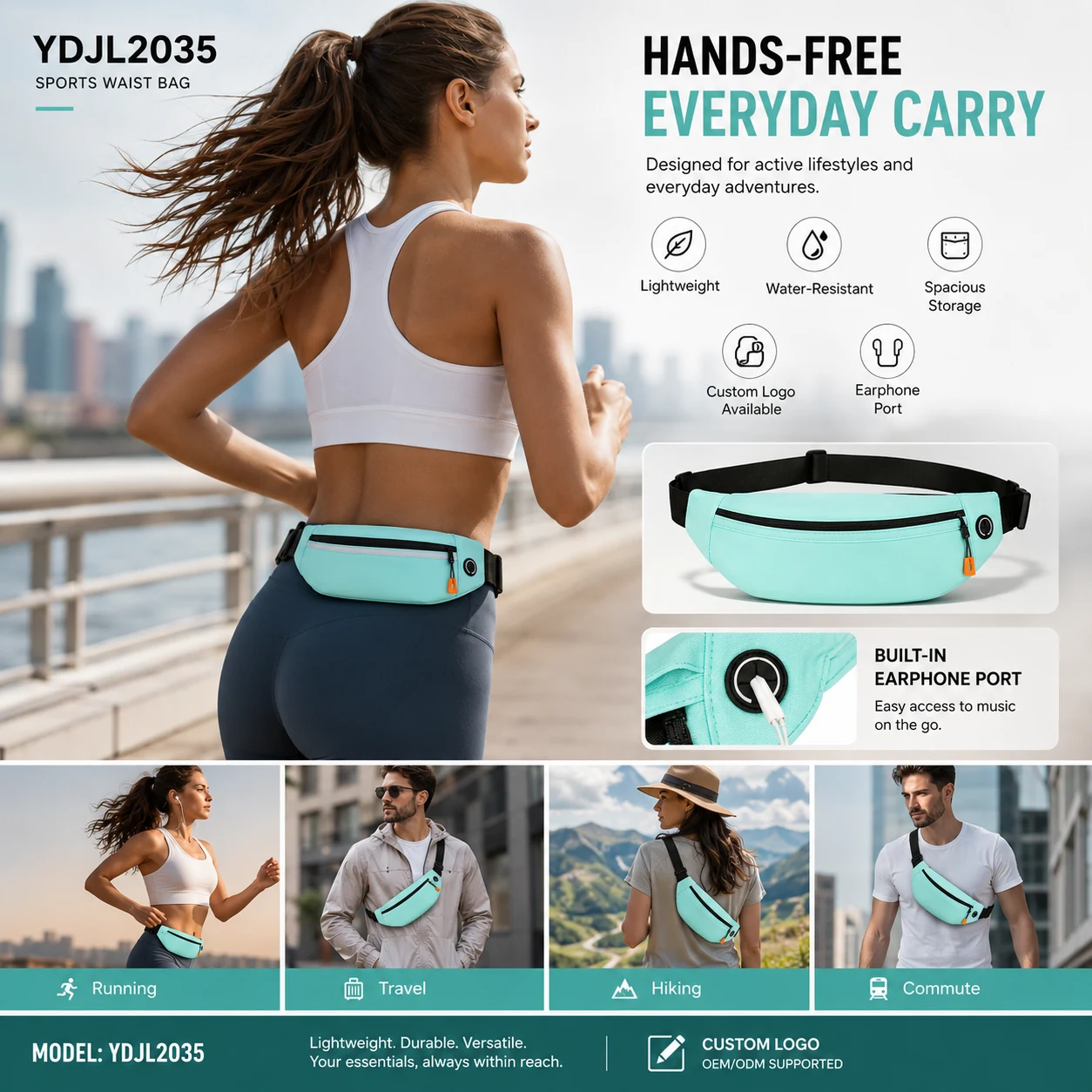
Short answer: they are the same category of bag, but built for different problems. A fanny pack is built to carry things and look good doing it. A running belt is built for one thing — not moving while you move. If your bag bounces when you run, that is a construction problem, not a size problem.
Most people comparing the two are really asking one question: will this thing jump around while I run? So let's answer that first, then cover everything else.
What actually causes bounce
Bounce is not about how much you carry. It is about how the load is held against your body.
| Cause | What happens | What fixes it |
|---|---|---|
| Rigid webbing strap | The belt holds its shape while your waist moves. A gap opens on every stride and the bag drops back into it | Elastic or partly elastic band that follows the body |
| Narrow band | Load concentrates on a thin line, so the bag rocks around it | Wider contact area spreads the load and resists rotation |
| Slippery outer fabric | The belt migrates downward until it finds your hips, then swings | Textured or silicone-backed inner face |
| Loose adjustment | Any slack becomes travel | Adjustment that holds under repeated load, not just when you fasten it |
| Load hanging below the band | The bag pendulums from the strap | Bag body integrated into the band, not suspended from it |
Notice that four of the five are about the belt, not the pouch. That is the real difference between the two styles.
The honest comparison
| Fanny pack | Running belt | |
|---|---|---|
| Primary job | Carry and look good | Stay still |
| Band | Usually webbing with a buckle | Usually elastic, wider, often silicone-backed inside |
| Bag position | Hangs from the band | Integrated into the band |
| Capacity | Larger, structured | Smaller, close to the body |
| Access while moving | Awkward | Designed for it |
| Off-duty look | Yes | Usually not |
| Best for | Travel, festivals, daily carry, hands-free city use | Running, hiking, gym, anything repetitive |
Crossbody slings sit in between. The diagonal strap gives more stability than a loose waist belt and more capacity than a running belt, but the bag still sits away from your centre of mass, so it swings on faster movement. Good for walking and travel, less good for running.
So — can you run with a fanny pack?
Yes, with two conditions:
- Wear it high and tight, at the natural waist rather than the hips. Lower means more swing.
- Fill it. A half-empty pouch shifts its contents on every stride, which reads as bounce even when the belt is fine.
If you are running more than a few kilometres, or carrying a phone, a purpose-built belt will be noticeably better. For a walk, a market run or travel, a well-fitted fanny pack is fine.
If you are producing your own — what to specify
This is where most custom projects go wrong. The pouch gets all the attention and the belt gets none, and the finished bag bounces.
Specify these:
- Band construction — elastic, webbing, or a hybrid. This single choice decides most of the bounce behaviour
- Band width — wider spreads load and resists rotation; narrower is lighter and less visible under clothing
- Inner surface — plain fabric, textured, or silicone-printed grip
- Adjustment type — buckle, slider, hook-and-loop, or fixed sizing. Fixed sizing means you need a size range, which means more SKUs
- Waist range — decide the range before pattern making, not after
- Closure — zipper type and pull; a hard pull tapping the body is a complaint you will hear about
- Component brands — webbing, elastic, buckles and zippers can be sourced to a brand you specify. If you have a preference, name it at quotation stage; if you don't, we will propose one and confirm it with you before sampling
- Whether the pouch is integrated or hung — the biggest single factor in stability
Also worth deciding early: reflective detail placement, a headphone or cable port, whether a race bib clip is needed, and whether the fabric needs to be water-repellent or fully coated.
Common mistakes
"Bigger is safer." Extra volume you do not fill is extra movement. Size to the actual contents.
"Any elastic will do." Elastic that relaxes after a few wears turns a good belt into a loose one. Recovery matters more than initial stretch.
"We'll sort the belt in production." The belt is the product. Deciding it late usually means accepting whatever is available.
What we make
Waist bags and belt bags are what this site is built around. Cutting, sewing and assembly are done in our own workshop, along with printing, embroidery and heat-transfer labelling. Webbing, elastic, buckles and zippers are sourced to your specification — including a named brand if your project requires one — and checked here before production starts.
A running belt and a fanny pack run down the same line here: on a 3,000 m² sewing floor in Baigou, where simpler constructions like these run at around 200,000 units a quarter. That is why a band swap between samples is a change of operation, not a change of supplier. Our Tianjin team handles export once the specification is settled.
Sampling generally runs 7–15 days depending on how complex the customisation is. Bulk timing depends on quantity and is confirmed with you before the order is placed.
MOQ from 50 pcs*
Send us the use case — running, travel, retail, event — plus your target quantity and any reference you like. We will tell you what construction fits, and what we would not recommend.
Final MOQ depends on style, fabric and logo method. Anna will confirm in your quotation.